
Key takeaways from landmark EU AI Act

[PLACEHOLDER]

 Recently, the European Parliament voted and passed the landmark EU AI Act. It's the first of its kind and sets a benchmark for future AI regulations worldwide.

The EU AI Act lays the foundation for AI governance, and it's pertinent for organizations delving into AI systems to comply with the legislation, build robust and secure AI systems, and avoid non-compliance fines. 

curly-haired-woman-looking-at-the-printed-paper
Photo by Karolina Grabowska via Pexels

My three key takeaways from the legislation are as follows:

  • The Act introduces the definition of an AI system:
    • "An AI system is a machine-based system designed to operate with varying levels of autonomy and that may exhibit adaptiveness after deployment and that, for explicit or implicit objectives, infers, from the input it receives, how to generate outputs such as predictions, content, recommendations, or decisions that can influence physical or virtual environments"
  • The Act introduces the classification of AI systems based on risk to society. The Act outlines four risk levels:
    • Unacceptable risk: An AI system that poses an unacceptable risk must be prohibited. Examples of these systems include AI systems driving facial recognition. 
    • High risk: AI systems that pose a high risk to society must comply with a range of requirements, including testing, data training, and cybersecurity, to ensure they comply with governing EU laws. Examples of these systems include automated insurance processing using AI. 
    • Transparency risk: These include limited-risk chatbots, deep fakes, and AI-generated content that must comply with transparency requirements. 
    • Minimal risk: These include common AI systems like spam filters and recommendation engines, which pose minimal risk to society and must follow currently applicable legislation, including GDPR.
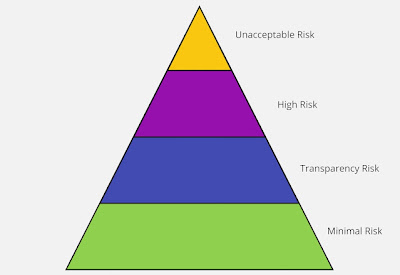
Pyramid-risk-to-society-4-risk-levels
Pyramid representing risk to society - 4 risk levels

  • Fines for non-compliance: The severity of the infringement determines the fine. It can be up to 30 M euro or 6% of the total worldwide annual turnover, whichever is higher. 

The EU AI Act lays the foundation for AI governance

Photo by Kindel Media from Pexels modified with Adobe Firefly


Reference

Artificial intelligent act
AI Act press release
AI Act

Trending posts

Apple's App Tracking Transparency sealing Meta's fate

If you have been following the recent news on Meta (formerly Facebook) you may have read that Meta recently projected their ad revenue will be cut by a staggering $10 billion in 2022 due to Apple’s new App Tracking Transparency feature (also known as ATT). This has resulted in Meta’s stock to plummet by over 20%. Photo by julien Tromeur on Unsplash - modified by Beolle So what is Apple’s ATT and how does it impact ad revenue? Apple has been releasing multiple privacy features for the last few years. This included Apple’s Mail Privacy Protection and Apple’s App Tracking Transparency feature. You can learn more about Apple’s Mail Privacy Protection in our earlier post by clicking here .  Apple’s App Tracking Transparency (ATT) was launched in iOS 14.5 and iPadOS 14.5 where it prompted users to select if they wanted the app to track their activities across other apps on the device. The prompt is displayed when the user opens an app like Facebook or Instagram for the first time o...

SLA-SLO-SLI and DevOps metrics

Companies are in need of the metrics that will allow them to stay in business by making sure they meet the expectations of their customers. The name of the game is higher customer satisfaction by winning their trust and loyalty. To do so, you want to provide good products and services. Therefore you need to find ways to monitor performance, drive continuous improvements and deliver the quality expected by the consumer in this highly competitive market. Photos from AlphaTradeZone via Pexel and Spacejoy via Unsplash SLAs, SLOs and SLIs are a good way to achieve the above. They allow clients and vendors to be on the same page when it comes to expected system performance. If we go one level deeper, vendors/providers work on NFRs (Non-Functional Requirements) when working on their solutions. NFRs define the quality attributes of a system. I bring them up because the relationship between them and the SLAs is that they provide, in a way, foundational aspects for the SLA-SLO-SL...

SRE, DevOps and ITOps

 If you are wondering what the differences between the SRE and DevOps are, as well as how these roles work with ITOps within an organisation then you are not alone; and best of all you are on the right blog post. Often enough business units in a company get confused, assigning the ServiceNow or Jira tickets or any other ticketing system of your preference, to the wrong group, and even having the incorrect expectations when doing resourcing. Let us go through definitions, insights and scenarios that will help you understand the difference. DevOps software development operations - AI Generated When it comes to DevOps and SRE, then you might be wondering which practice came first. While SRE may have originated a bit earlier, internally at Google, DevOps came first publicly as a practice and started to be used by companies. A few years later was when Google decided to open SRE to the world after the publication of the "Site Reliability Engineering" book. Therefore, technically sp...

Assembling MLOps practice - part 2

 Part I of this series, published in May, discussed the definition of MLOps and outlined the requirements for implementing this practice within an organisation. It also addressed some of the roles necessary within the team to support MLOps. Lego Alike data assembly - Generated with Gemini   This time, we move forward by exploring part of the technical stack that could be an option for implementing MLOps.  Before proceeding, below is a CTA to the first part of the article for reference. Assembling an MLOps Practice - Part 1 ML components are key parts of the ecosystem, supporting the solutions provided to clients. As a result, DevOps and MLOps have become part of the "secret sauce" for success... Take me there Components of your MLOps stack. The MLOps stack optimises the machine learning life-cycle by fostering collaboration across teams, delivering continuous integration and depl...

This blog uses cookies to improve your browsing experience. Simple analytics might be in place for pageviews purposes. They are harmless and never personally identify you.

Agreed