
Mobile Applications have become an integral part of our daily lives - we use mobile apps as alarm clocks to wake us up in the morning, to create to do lists when we start our day, to communicate with our colleagues at work via apps like Skype. We even check reviews of restaurants to visit on apps like Yelp and we seek entertainment on apps like Netflix and spotify. So what drives us to use these apps so seamlessly in our daily lives? Why we prefer some apps over others? Is there a science behind designing successful mobile apps like Facebook?
 |
| Photo by Peter C from Pexels |
A study in US revealed that a user between the age of 18 and 44 visits the Facebook app on average 14 times a day [1]. This shows that using the Facebook app is a daily routine for many of its users. This makes Facebook a great example of a habit forming mobile app which is designed with human psychology in mind that encourages habit forming behavior in its users.
I recently attended a seminar on the design of such habit forming mobile apps at Brainstation, a new educational institution perched at the heart of downtown Toronto. The seminar was presented by Humayun, a product designer by profession.
Humayun credited Hook’s model as the key science behind designing a habit forming mobile app.
Hook’s model is a cycle with four stages of user involvement that encourage habit forming behavior. Repetitive iterations of these four stages can reinforce a user behavior which can eventually lead to a habit.
The four stages of Hook’s model are:
- Trigger
- Action
- Reward
- Investment (for future trigger)

Stage 1: Trigger
The trigger is the instigator of a behavior. In relation to the Facebook app this is the “urge” to use the app. There are two types of triggers that drive human behavior:
- External triggers like a push notification, text message, email, link to a website
- Internal triggers like emotions, routines, urges to open an email or share a photo
According to Hook’s model the goal of habit forming technology is to convert these external triggers into internal triggers. In case of Facebook it uses external triggers like push notifications and news feed updates to actuate internal triggers of curiosity and intrigue to bring its users back to the app. Over time this can easily develop into a routine urge to find out about the activities of Facebook friends and a habit can be formed.
Stage 2: Action
If the trigger is successful it can lead to an action. An action is dependent on two key factors:
- Motivation of the user to use the app
- Ability of the user to use the app
Apps like Facebook increases the odds of a user using its app by feeding the motivation of the user to access its app and by making the app super easy and intuitive to use. The key drivers of user motivation is the anticipation of hope, pleasure and social acceptance.
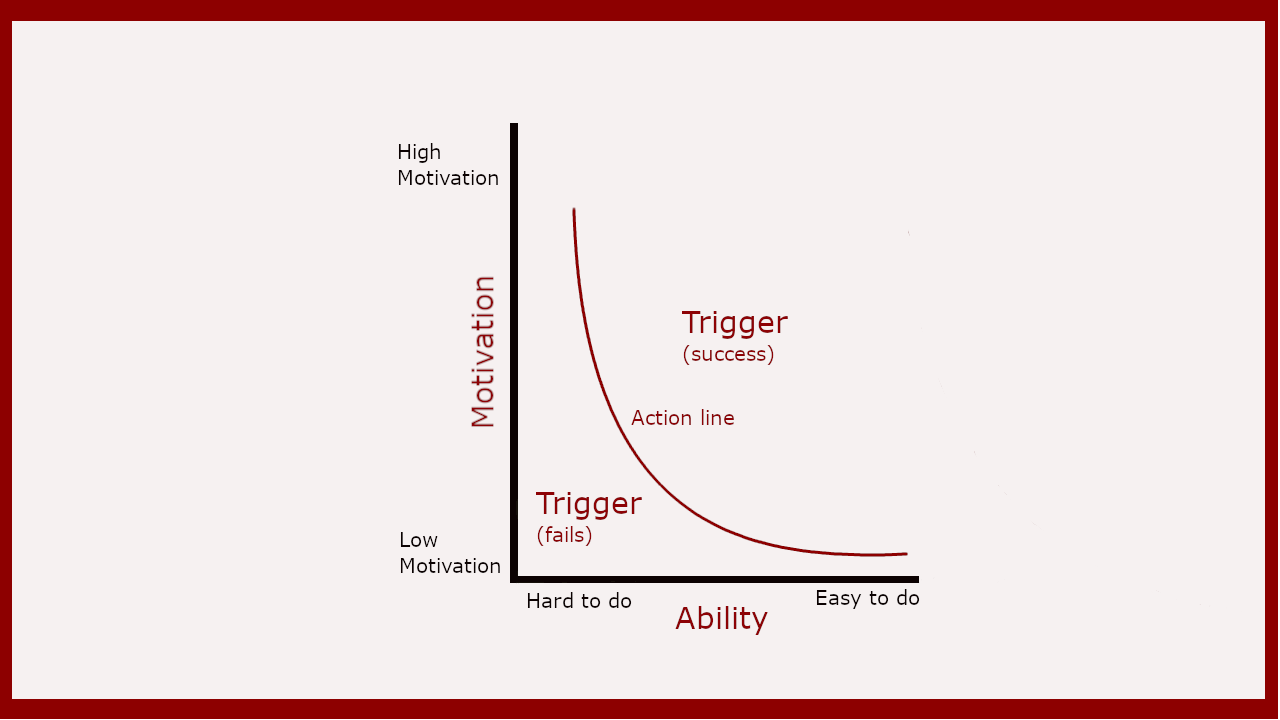
This is outlined by BJ Fogg’s Behavioral Model which states that if the motivation and the ability to use the app is high then the triggers will typically lead to an action i.e. accessing the app. Whereas if the motivation and the ability is low then it’s harder for the trigger to lead to an action. For example if the Facebook app is really hard to use and/or if there is no updates in the news feed then the user may be unlikely to check the app even if he/she has an urge to use Facebook. This is because he/she knows that there are no new updates and hence is less inclined to access the app. Instead he/she may use another social media app like twitter where there are new updates. This is one of the reasons Facebook introduced the trending module where it displays popular news to compete with the likes of twitter.
To sum up according to BJ Fogg,
Action is a result of Motivation + Ability + Trigger all at the same time.
Action is a result of Motivation + Ability + Trigger all at the same time.
BJ Fogg Behavior Model
Stage 3: Reward
The reward is the outcome of a successful action. There are three types of rewards that users seek:
- The reward of the self - this reward mostly applies to games that leads to mastery and self actualization
- The reward of the tribe - this reward refers to the human need to connect and share and apps like Facebook is adept at sufficing this need by connecting its users with friends and family
- The reward of the hunt - this reward refers to the material acquisition like gaining monetary value. This also refers to the searching for songs, reviews, deals, discounts, etc.
An effective habit forming app must provide at least one of these rewards to motivate its users to keep using the app. There are number of apps like Spotify that rely on a combination of all three rewards:
- Spotify provides the reward of self by allowing its users creative expression as they create their song playlist
- Spotify provides the reward of the tribe by allowing its users to share their playlist with friends
- Spotify provides the reward of hunt by allowing its user to search for the “perfect” song to suit their mood
Stage 4: Investment
The Investment is the last stage of the Hook’s model and allows the users to have a skin in the game. This is to increase the odds for the user to revisit the app. In Facebook app the investment is the user leaving a comment on a friend’s post. This generally leads to more user engagement as the friend replies back.
This can lead to future triggers like push notifications to the user as others add comment to the friend's post and the Hook’s cycle restarts.
In conclusion designing a Habit forming mobile application can be the difference between a successful and an unsuccessful app. Apps like Facebook, Instagram, Spotify, etc. have already proved the power of Hook’s model and how it can be applied to design mobile apps that lead to higher traffic and greater usage. This greatly increases the user engagement with the app and develops user loyalty.
Reference:
[1] http://mashable.com/2013/03/27/facebook-usage-survey/#CZAeDRZGxPqD 


